American Express
Simplifying Business with Cash Back
Research
Positioning
Messaging
GTM Playbook
Partnered with cross-functional marketing, product, and insights teams to support the launch and positioning of new American Express business products. Conducted and synthesized customer research, facilitated stakeholder alignment, and helped translate strategic positioning into customer-facing GTM frameworks.

Lower Eastside Girls Club
This One’s for the Girls...Revolution
Cultural Insights
Workshop
Brand Identity
Lower Eastside Girls Club is a NYC institution deserving of a brand identity as bold and cohesive as its mission. Our work began with a deep exploration of “girlhood” across its many eras — Validation, Reclamation, and Revolution — and identified LESGC as a brand driving toward Revolution: reimagining systems that work better for women and girls. That forward-looking spirit informed a comprehensive identity system inspired by protest movements, collective power, and the energy unlocked when girls show up for one another.
For the full case study of our strategy and design process, view SYLVAIN’s website.
For the full case study of our strategy and design process, view SYLVAIN’s website.

DoorDash
Turning food justice into celebrations
Activation
Brand Design
Service Design
Contactless delivery became a necessity in 2020, and we realized how essential the drivers are who connect people to their communities. In America, many of these communities are made up of people facing issues much greater than social distancing. In a time of racial reckoning, DoorDash knew it had to plant its flag on higher ground. This January, DoorDash challenged 7 teams to develop a campaign that could create an impact. Our team was awarded first place in this competition.
Instead of speaking about diversity, we wanted DoorDash to go directly to the communities in need and help in the best way they know how. Our solution focused on confronting very real, systemic barriers, while putting human connection first.
Instead of speaking about diversity, we wanted DoorDash to go directly to the communities in need and help in the best way they know how. Our solution focused on confronting very real, systemic barriers, while putting human connection first.

The Challenge
How can DoorDash utilize its ability to connect people to the places and faces in their neighborhood to be a champion for racial progress in underserved communities?

“When America catches a cold,
Black America catches pneumonia.”
Key Findings
1
Schools that need meal distribution the most are the ones that can’t afford to implement it. Additional packaging, pre-portioned meals, and PPE are cutting into already thin budgets.2
Due to systemic barriers, food insecurity disproportionately impacts Black communities. Since the start of the pandemic, food insecurity has nearly doubled. 3
Children in food-insecure households would normally receive two meals a day at school. Only 15% of children eligible for free or reduced lunch are actually receiving those meals during COVID.TLDR: For many students, school closures meant going hungry. This disproportionately affects the Black community.
Strategic Positioning
An impact-driven initiative that leverages DoorDash’s expertise to create meaningful, long-lasting change while championing a beloved community member to address food insecurity in children.
The Concept
The Original Dasher
If DoorDash connects you to the places and faces in your neighborhood, no one does this better than your school bus driver.
Focusing on re-employing bus drivers turns this into a celebration of community, rather than a focus on need.
︎︎︎

An initiative that brings the original dashers—bus drivers—back to underserved neighborhoods to provide meals to children who are missing out on school lunches and more during COVID.
Involve the Community
Make it easy for the entire community to contribute and make an impact. By featuring Project Yellow Bell as a restaurant on the app, users can sponsor a meal to help offset the cost in the school district nearest to them.


Packaging
Project Yellow Bell can reduce the strain on school budgets by stepping in with branded packaging. These reusable lunch bags not only spotlight the initiative but helps schools reduce costs to repurpose elsewhere.
Celebrating the Stories
Dedicate a microsite to the original dasher—school bus drivers—and the way their presence in the community helps bring it back together.


We are currently working with DoorDash and The Martin Agency to bring Project Yellow Bell to life!
Please reach out with any questions or updates on this ongoing initiative.
Check out my talented group members:
Courtney Tibbetts, CW
Alexandria Reid, CBM
Joe Mrava, XD
Marnie Abraham, ST
Chris Cole, AD
Elmer’s
Expanding the perception of slime
Innovation
Brief Writing
Brand & Product Design
Elmer’s couldn’t keep glue on shelves as the slime revolution spread around the world. Teenagers turned their families into small businesses as they found success selling slime online. Content creators get billions of views from unique slime creations, product reviews, and ASMR videos. There’s even a museum in Manhattan for those who want to get their hands busy and senses engaged.
The surprisingly lucrative business of slime is more than just a “satisfying” social media trend for kids. People are missing out on creativity, stress relief and mindful benefits because they’ve never considered it more than a tween thing. This project was originally a brief written by my strategy partner Marnie and I. A few months later, the brief attracted a group of creatives who wanted to bring it to life.
The surprisingly lucrative business of slime is more than just a “satisfying” social media trend for kids. People are missing out on creativity, stress relief and mindful benefits because they’ve never considered it more than a tween thing. This project was originally a brief written by my strategy partner Marnie and I. A few months later, the brief attracted a group of creatives who wanted to bring it to life.
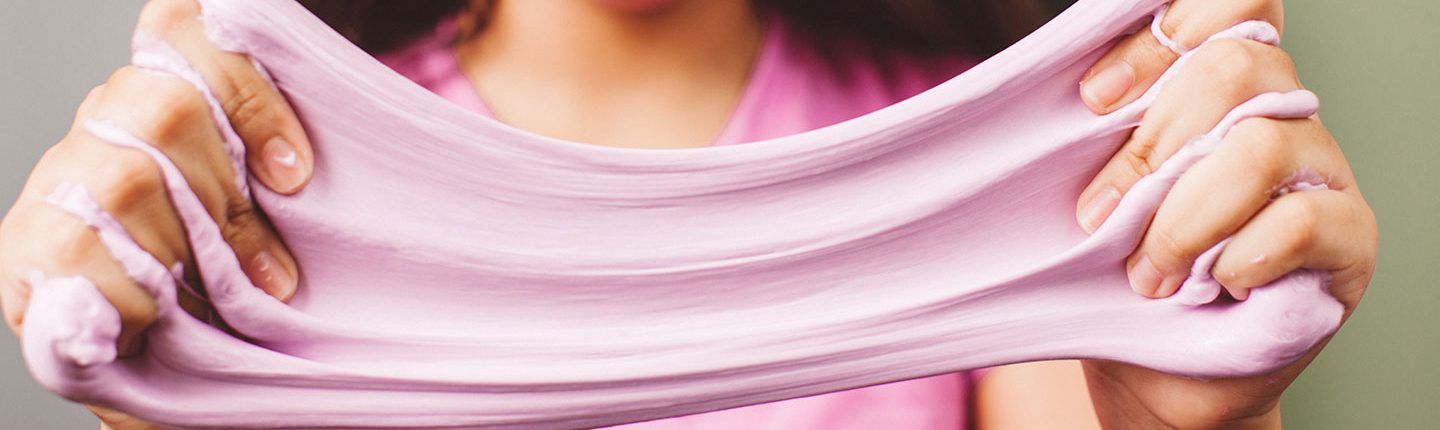 Photo by Marilyn Nieves
Situation
Slime, a popular DIY activity, has taken the world by storm. Elmer's glue, an essential ingredient in slime, has benefited greatly from the slime revolution.
Problem
The conversation is stuck on pre-teens and slime is perceived as purely juvenile.
Finding
Slime is more than just a kids toy. Approximately half of slime purchasers are people over thirty. Adults who appreciate slime say it helps express creativity, reduce stress and anxiety, and focus attention on something playful.
Insight
Slime is somewhere between art and a stress ball.
Oppurtunity
People can manage their stress levels by dedicating their personal attention to something tactile and pliant. This can be in the form of exclusive collectibles by Elmers.
Strategy
Slime does more.
Solution
A stunt that involves a limited edition collection of exclusive sensory fashion collectibles by Elmers. Before revealing that Elmer’s is behind the collection, the brand can show up in a heightened, mainstream way to effectively gain attention and shift perception to the infinite possibilities of slime.
The Idea
Le’Mers
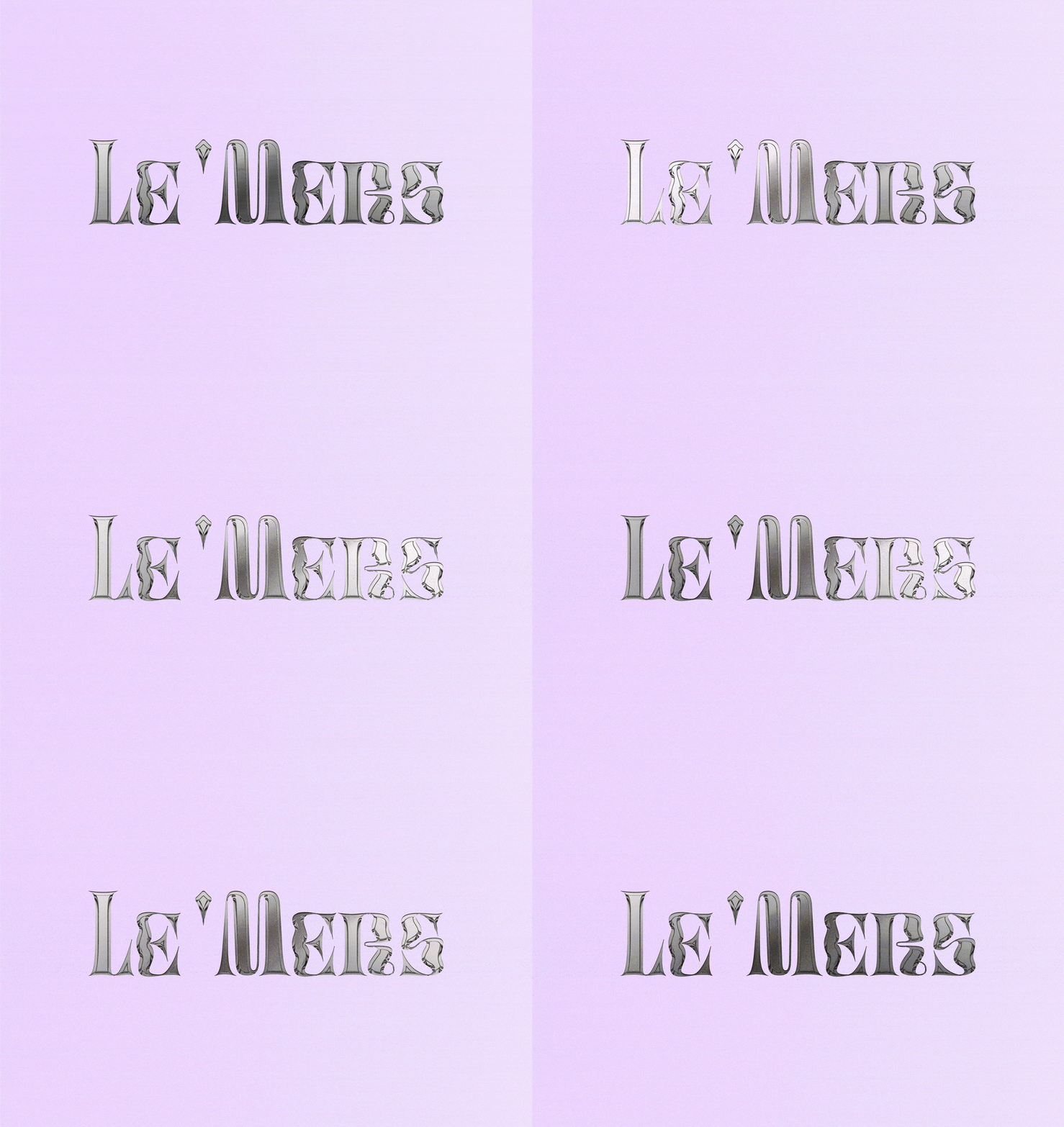
Alternate Theraputic Reality Pop-up
A whimsical installation will be open to the public for only a few days, where a limited amount of fashion items, lined with slime, will be sold to those who can make it to the Bonneville Salt Flats. 


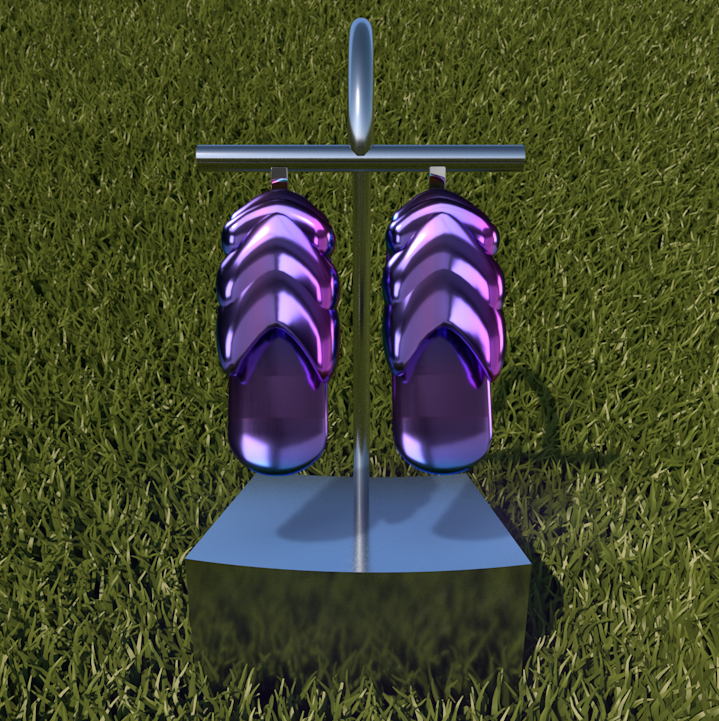
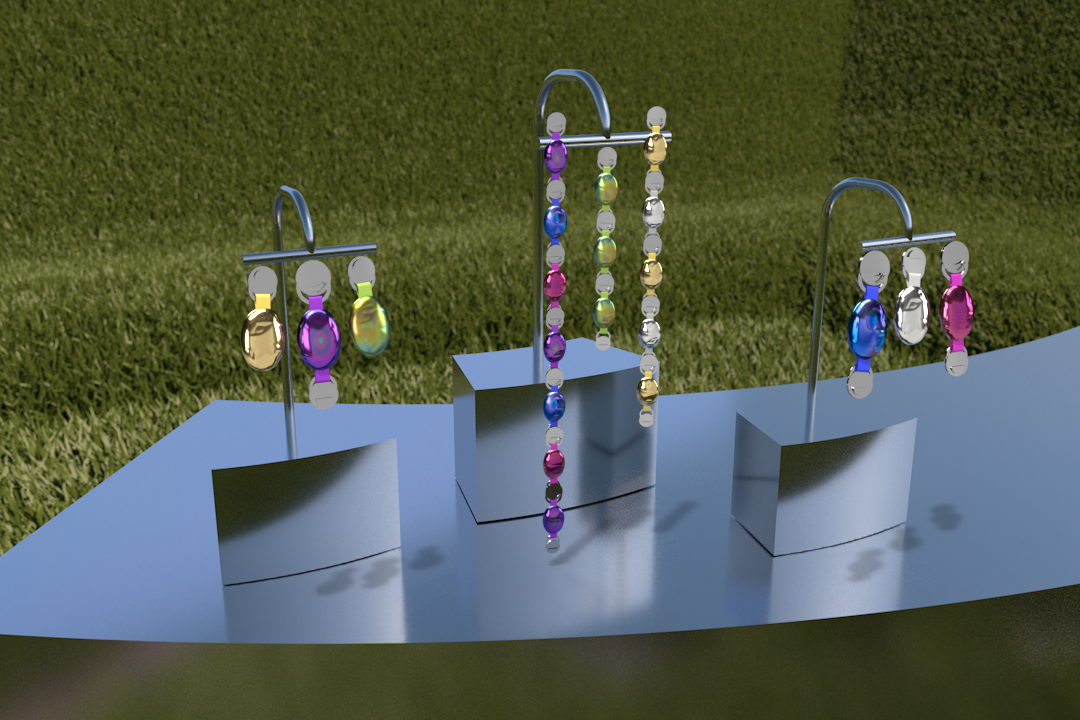

The Le’Mers collection is for those who crave texture, color, and play. These items are designed with fidget spinners and stress balls in mind, which can help with distraction control, mindfulness and meditation, and stress relief. Exquisitely squishy, luxurious, and exclusive.


Le’Mers on social
@Le_mers_official on Instagram is the only place to buy collectibles outside of the pop-up installation. These accessories can be attached to each other, used as keychains, or carried solo.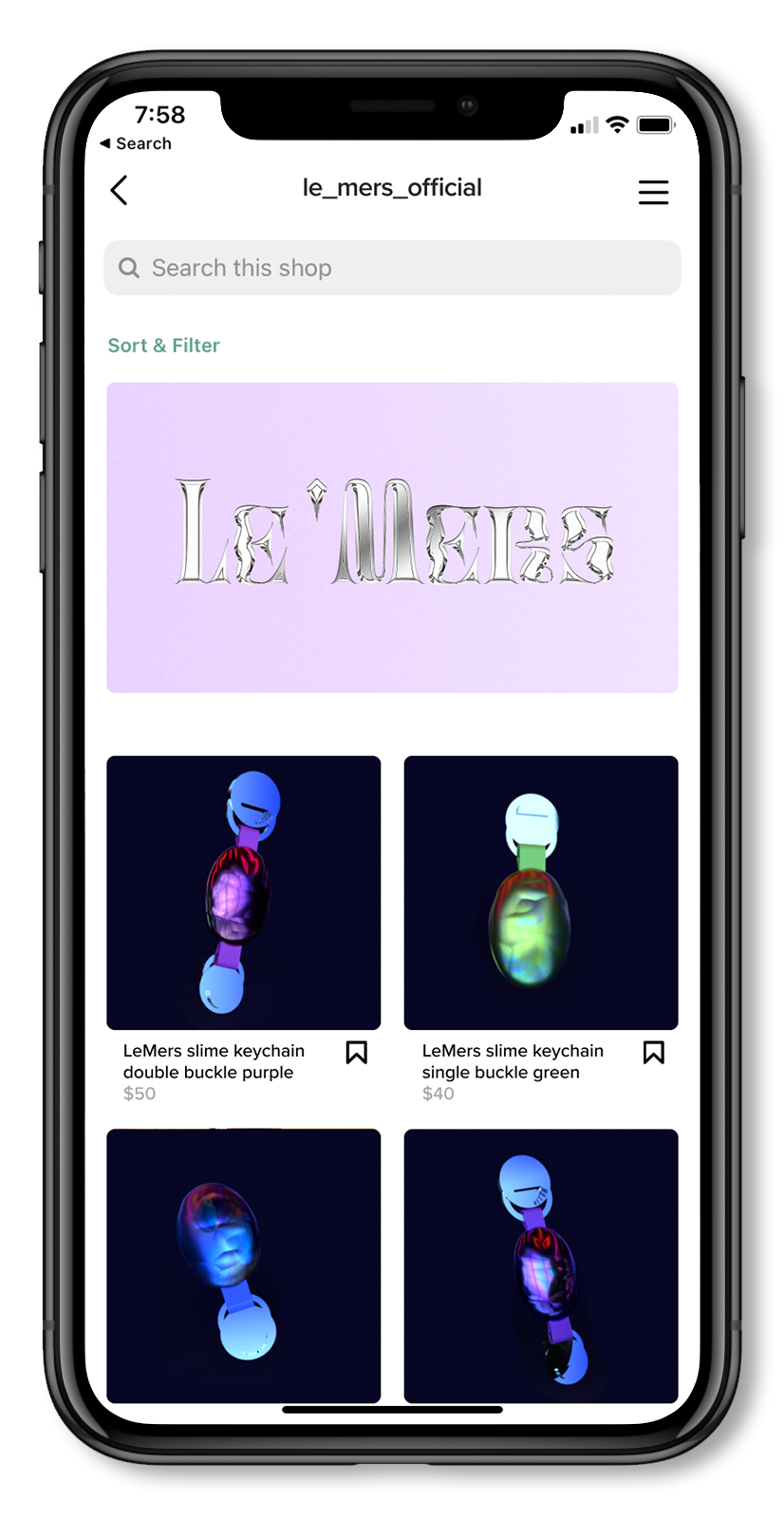

Le’Mers will get help from influencers like @lilmiquela and Emma Chamberlain to spread the word on Instagram.


This stunt will create conversation and show that the applications of slime are infinite and for people of all ages. Le’Mers is just the start for Elmer’s to show that Slime does more. Next up, self care startup called Wellmer’s.

My group of slimers:
Truth in America
Deep dive into America’s culture of lies
Interviews
Writing
Design
The war on truth did not begin in 2020, though the stakes were raised to an insurmountable level in 2020 with the spread of COVID-19, countless protests for racial justice, and the most expensive election in history ($14.4 billion!) When Nonfiction Research approached my team with a burning question on truth, we turned to philosophy, spirituality, and psychology.
Our deep-dive included interviews with a psychologist, a psychic, a QAnon supporter, an ex-Morman drag queen, and a Pulitzer Prize-winning author and scholar. We also surveyed hundreds of strangers to see how many Americans have recently cut someone out of their life due to conflicting beliefs. (The answer? 35 million.) After weeks of interviews, infiltrating online groups, academic journals, stories from former cult-members, and more, we decided to publish our findings in the form of a zine.
Our deep-dive included interviews with a psychologist, a psychic, a QAnon supporter, an ex-Morman drag queen, and a Pulitzer Prize-winning author and scholar. We also surveyed hundreds of strangers to see how many Americans have recently cut someone out of their life due to conflicting beliefs. (The answer? 35 million.) After weeks of interviews, infiltrating online groups, academic journals, stories from former cult-members, and more, we decided to publish our findings in the form of a zine.


Background
Charles Darwin probably didn’t know when he set sail on The HMS Beagle, that his theory of evolution would influence a nation’s concept of truth. But it did. A few decades after Darwin’s On the Origin of Species, pragmatism, America’s philosophy, was born. And with it came a distinctly American set of beliefs about truth. The pragmatists believed that true ideas are those which help us adapt to our environment. Truth is what is useful—and just like our physical traits must evolve to suit reality, so must our beliefs. In this marketplace of ideas, the best idea wins.
Thesis
The marketplace of ideas has been hacked.
![]()
Misinformation has hacked the competition and “shoppers” are living in different realities. How did we get to such a divided state?
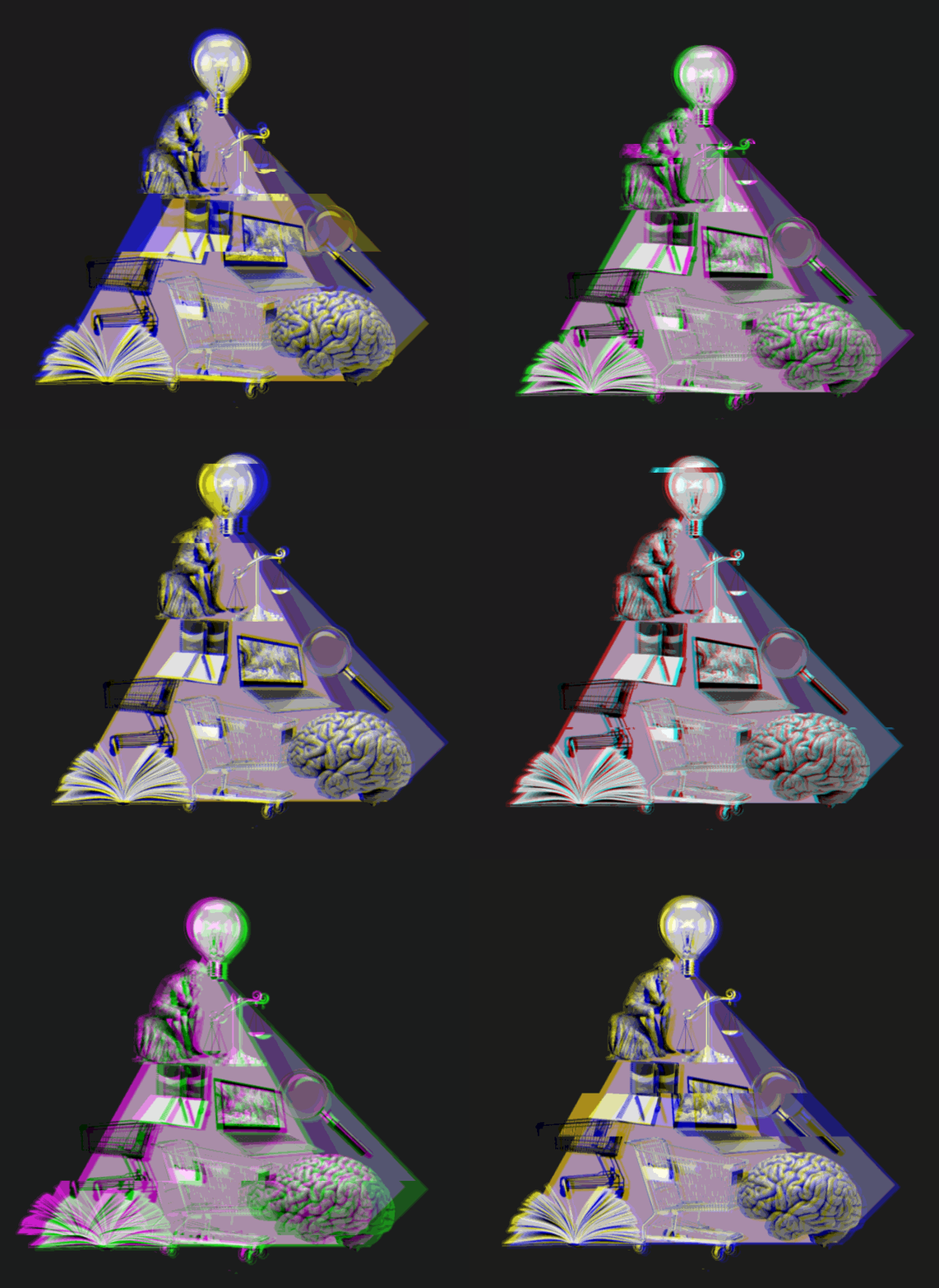
Misinformation has hacked the competition and “shoppers” are living in different realities. How did we get to such a divided state?
Forming Beliefs
Dr. Joseph Pierre, Professor of Psychiatry at UCLA, explains that our intuition (what “feels right”) and our subjective experience are the two most important reasons why we believe something to be true. With countless inputs and subjective experiences to draw from, it’s easy to see why so many different versions of truth compete with each other. Our beliefs are not the outcome of a lifetime of rational, objective investigation and reasoning. They are opinions explaining things left unsolved.
Throw in social identity theory, (belonging to groups) winner and loser effect (2 party-system) and confirmation bias, (ignoring any contradictory information) and it’s no surprise that the country reached such an extreme level of polarization. When there’s only an option to either win or fail, who wouldn’t want to find “truths” that support their side?
Throw in social identity theory, (belonging to groups) winner and loser effect (2 party-system) and confirmation bias, (ignoring any contradictory information) and it’s no surprise that the country reached such an extreme level of polarization. When there’s only an option to either win or fail, who wouldn’t want to find “truths” that support their side?
The Hero Paradox
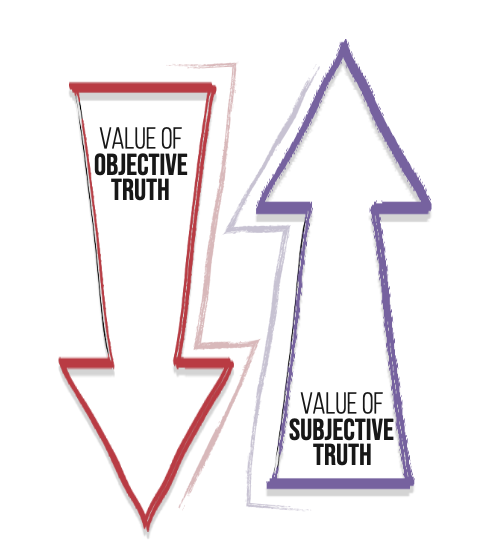
This is the trend of truth in America. It is harder than ever to find agreement on objective truth. We call it the Hero Paradox because people take it upon themselves to be a detective and stand up against the problems of humanity. While intentions might be good, it is paradoxical because no matter what evidence is laid before us, our instinct remains to keep ourselves centered as the heroes of our own stories.
Finding “truths” is not hard to do when considering our natural instincts. Apophenia is “the tendency to perceive a connection or meaningful pattern between unrelated or random things (such as objects or ideas).” We can’t help but look for patterns—seeing them has helped us survive as a species. We want our side to win because we believe it has to be right.
In a marketplace of ideas, healthy skepticism is inevitable and even encouraged. And it’s understandable that we push for better answers when we feel doubt. The Socratic method and “liberation by truth” are very attractive concepts to people who feel unsatisfied with the system. Truth Seekers take skepticism to an unparalleled place, and most of the theories spread by independent thinkers tie back to a deep mistrust of the government. In fact, people are eager to share their stories of how they were personally failed by the system.
The Future
Needs Objective Truth
Needs Objective Truth

We have successfully fallen trap to Red Herrings: lies to distract us from our real problems. Meanwhile, irreversible damage is being done to our planet, and experts argue that a majority of the COVID deaths in America were avoidable. The allostatic load from defending our beliefs and the high stakes of good versus evil can cause anxiety, depression, even shortened life expectancy.
The marketplace only works if we are committed not to one single conception of truth, but to the process of letting truths be tested, verified, and maybe even abandoned. Only then can our truths evolve to meet the challenges we face.
My group of truth seekers:
Sheila Villalobos (ST)
Allison Schneider (ST)
Joseph Koroma (ST)
Allison Schneider (ST)
Joseph Koroma (ST)